
Documents Within Rice County Deed Records
The Rice County Register of Deeds records far more than deeds. Patents, mortgages, leases, assignments, releases, affidavits, corporate instruments, death certificates, powers of attorney, military discharges, plats, surveys, UCCs, tax liens, cemetery plats, ordinances, and resolutions all pass through the office. The deed type hints at why a transfer happened. It never replaces reading the instrument itself.
| Deed Type | What It Does | Common Use |
|---|---|---|
| Warranty deed | Conveys the stated interest with covenants in the instrument | Ordinary negotiated conveyance |
| Quitclaim deed | Conveys whatever interest the grantor has without the same warranties | Corrective or interest-cleanup transfer |
| Executor or trustee deed | Conveys through a fiduciary acting under authority | Estate or trust administration |
| Sheriff or tax deed | Records a transfer following the applicable legal process | Foreclosure or tax-sale trail |
| Affidavit or death certificate | Supplies facts that may explain a change in the chain | Death-transfer and estate research |
Mortgages, liens, assignments, and releases create encumbrances. They are not the conveyance of ownership. Read each filing beside its later release, since an old mortgage entry alone says nothing about whether a debt is still open.
The Rice Recorder Is an Office Search
The Register of Deeds publishes no online grantor-grantee search form. Requests run through the courthouse, the telephone, or the mail. The office is at 101 West Commercial, Lyons, KS 67554, open Monday through Friday from 8:00 a.m. to 5:00 p.m. Call 620-257-2931. A sharp inquiry names the instrument type, parties, approximate recording date, and any book/page, instrument number, or legal description.
| Instrument type | Deed, mortgage, release, affidavit, plat, survey, lien, or another listed record |
|---|---|
| Party names | Legal grantor, grantee, debtor, or other indexed party names |
| Date range | A narrow approximate recording period |
| Locator | Book/page, instrument number, or legal description when known |
| Mail return | Self-addressed stamped envelope for mailed recorded documents |
The office’s public page,not an unavailable index,is shown in the captured source.
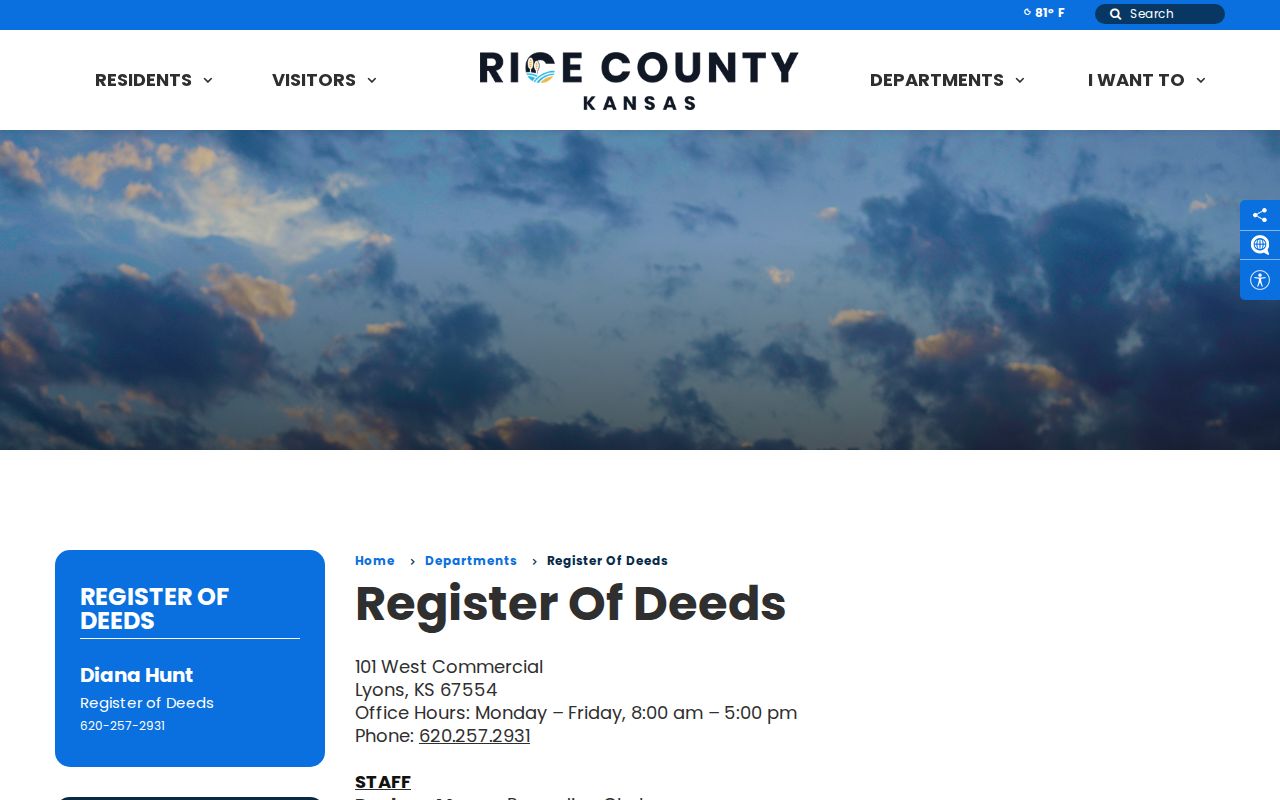
The instrument inventory, access rules, and fee schedule on the recorder's page help you plan a precise records request.
Why Rice County Does Not Perform Title Searches
The recorder is blunt on one point. The office does no title work or title searches. Its role is to accept instruments that meet recording requirements, index them, preserve them, and furnish copies. Judgment stays with the researcher. That person decides which instruments attach to one legal description, and whether a later correction, estate filing, lien, release, court order, easement, or plat changes the interpretation.
Recorded does not mean guaranteed. An indexed deed proves that an instrument was recorded; it is not a legal opinion that title is complete, valid, or free of other interests.
Read Rice County’s Grantor-Grantee Chain
Start with the newest conveyance. Keep a worksheet keyed to the legal description, because party names map the path while the land description proves each step concerns the same parcel.
- Find the newest deed naming the current recorded grantee.
- Copy its grantor, recording date, legal description, and book/page or instrument number.
- Search that grantor as an earlier grantee and compare the land description.
- Repeat, noting corrections, affidavits, plats, probate documents, mortgages, and releases.
- When an online or office index stops, ask which deed book, microfilm, or archive series continues the search.
- Grantor
- The party transferring the stated interest.
- Grantee
- The party receiving that interest.
- Chain of title
- The connected sequence of instruments for the same land.
- Book/page or instrument number
- The recording locator needed to retrieve a specific document.
Historic Rice Deeds Need More Than a Web Search
Older deeds test more than a search box. The Kansas Historical Society Rice County finding aid covers a broader county-record group from 1875 to 1940. It includes microfilm and related court and probate material. Those dates describe the archive's holdings. They do not mark the start or end of the Register of Deeds index.
Plat books add another layer. The Historical Society holds Rice County ownership maps and plat books from 1902, circa 1919, and 1971. Each snapshot helps with former names, subdivision context, and research leads. None replaces the deed chain.
Open the state's ownership-map and plat-book guide to explore the full list.
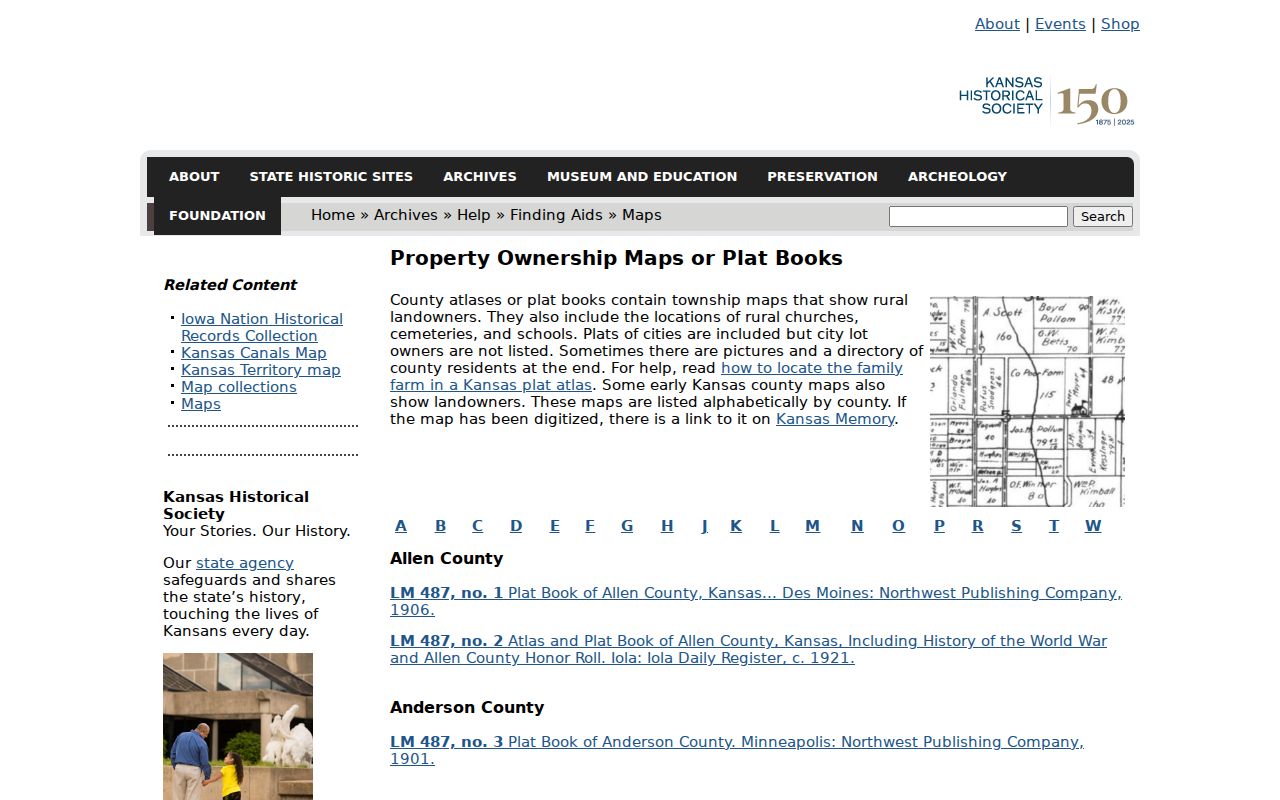
Use the dated entries to anchor your archive request.
Liens and Releases Beside Rice County Deeds
A complete trail gathers more than deeds. Mortgages, assignments, releases, tax liens, leases, easements, and lis pendens can all attach to a parcel. They can all attach to the same one. Match each filing to a later satisfaction or release. Use parties, dates, legal description, and recording references to do it. UCC filings follow separate rules and fees. A Secretary of State debtor result does not describe the land itself.
Plats and surveys answer their own questions. They explain a lot-and-block description, a replat, an access strip, or an easement. ORKA is a geographic aid. The recorded plat and survey remain the document sources. That distinction matters whenever the modern parcel outline disagrees with an older conveyance's language.
The Restricted Sales-Validation Record
Most Register of Deeds records in Rice County are open to anyone. The Kansas Real Estate Sales Validation Questionnaire is not. That record is limited to persons protesting taxes. It is also limited to Kansas Certified General Real Property Appraisers. Ordinary research loses little. A recorded deed's parties, date, description, and locator still answer most questions. Searchers should not expect questionnaire access, though. They should not guess at unverified consideration details.
Requesting a Rice County Deed Copy
Request a known instrument at the courthouse or through a targeted mail inquiry. The county offers no dependable online image route. Under the schedule effective January 1, 2018, ordinary copies run $1 for the first page and $0.25 for each additional page per document. Index pages, plats, and surveys cost $10 per page. A certified instrument certificate is $13. Confirm the current total with the office before you mail payment.
Recording fees are separate from copy fees. Deeds, mortgages, and other writings are listed at $21 for the first page and $17 for each additional page, while mortgage assignments and releases carry their own schedule. A mailed return needs a self-addressed stamped envelope. None of that makes the recorder a researcher; the office will not chase down an unidentified chain for a requester.
Check before relying. Fees may change, and a supplied copy is not a title opinion. Confirm the amount and document locator directly with the Rice County Register of Deeds.
Courthouse and KORA Routes for Rice Deed Research
Rice County keeps its deed records within easy walking distance. The recorder, Appraiser, Treasurer, Clerk, and District Court all sit in the Rice County Courthouse. An in-person cross-check works well when databases disagree. Direct each request to the right custodian. Deeds and plats belong to the recorder. Parcel cards go to the Appraiser. Tax balances go to the Treasurer. Court files go to District Court. For records questions under the Kansas Open Records Act, the Clerk serves as the county's KORA contact. Describe an existing record precisely. Ask for a fee estimate if retrieval may take time. KORA does not make the recorder a title researcher. A specific document request beats asking an office to hunt down every possible interest in a tract.