
Trace Who Owns Rice Property
An ownership check in Rice County runs from street address to recorded deed. The Appraiser's Orion system links an address to a parcel and an owner field. The tax portal offers a second name check. Its Current Owner, Taxpayer, and Both settings are not interchangeable, so choose deliberately. On the deed side, the grantee is whoever received the interest the instrument states. Match the legal description and parcel number across both sources before treating those names as one ownership chain.
- Enter the situs address in Rice County's Orion public access.
- Save the owner spelling, Quick Ref, parcel, and legal description.
- Ask the Register of Deeds for the newest matching conveyance.
- Compare its grantee, recording date, and land description with the roll.
- If an entity holds title, verify its Kansas filing without treating the resident agent as the owner.
Rice Owner Names Need Context
The tax search has a built-in control that resolves many apparent conflicts. Name Match Type can be set to Current Owner, Taxpayer, or Both. The portal itself recommends a last-name-only query. A taxpayer may simply be the person handling the account. This may not be the grantee on the latest deed. Mailing labels can also shorten an entity's name. Save the match type and tax year you used.
Do not expect the two systems to agree instantly after a transfer. Orion can show a later update date than the tax system. Because of this, the rolls may briefly conflict. A freshly recorded deed can predate both.
Names in the record
Owner of record is the name on the current public roll. Grantee is the party receiving the interest in a deed. Situs is the property's physical address, while the mailing address is where the owner gets notices.
Orion Starts the Rice Owner Check
The Rice County Appraiser's guide lists four keys Orion accepts. These are Name, Address, Quick Ref ID, and Parcel. Use them alone or together. Address is the clearest first key when the question is who owns this property. Quick Ref ID and parcel then bridge you to the tax and map records. Public access may redirect, or a card may be missing. The Appraiser says Property Record Cards may be requested by phone at 620-257-3830. The Orion entry screen shows the public-access route and its update context. It is not proof of any named owner.
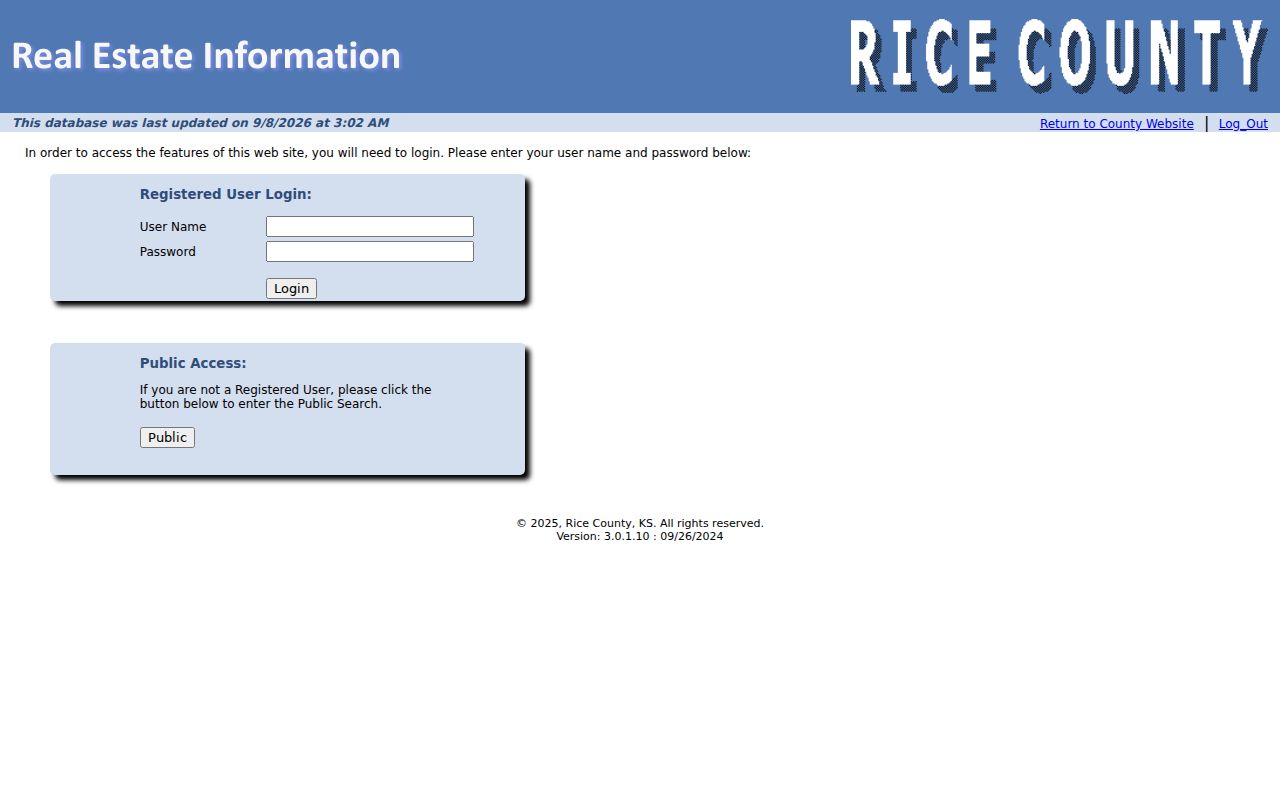
Use the returned parcel key to keep the owner check tied to the right tract.
Deeds Confirm Rice Property Owners
A roll is an administrative record, nothing more. The Register of Deeds holds the recorded transfer evidence. Rice County publishes no open deed-search form and no online coverage date. The dependable fallback is a focused request at the courthouse or by mail. Give the instrument type, the grantor or grantee, and an approximate recording date. Include any book, page, or instrument number. You can also give the legal description.
The office records deeds, patents, affidavits, mortgages, assignments, releases, and powers of attorney. It also holds death certificates, plats, surveys, and liens. So a transfer may rest on more than a warranty deed. Remember that the recorder does not perform title searches. Requesting a document and evaluating title are separate tasks.
Sources Naming a Rice Property Owner
No single screen settles every owner question. The roll gives the current administrative name. The deed gives the recorded conveyance. The map fixes the location. Use the Kansas entity database only to understand a named business.
| Source | Owner Info It Gives | Access |
|---|---|---|
| Appraiser Orion | Roll name, parcel keys, situs context | Public entry or phone card request |
| Rice tax search | Current owner, taxpayer, or both | Public online form |
| Register of Deeds | Grantee and vesting in the instrument | Courthouse or targeted mail request |
| Kansas SOS | Business status and resident agent | Public entity search |
| ORKA | Parcel location and nearby shapes | Warning acknowledgement, then map |
An owner name does not identify every person at the address. The situs could be vacant land, a business site, or a home whose tax mail goes elsewhere. Keep occupants out of the ownership conclusion unless a separate lawful record supports that distinct fact.
LLCs and Trusts in Rice Records
When an LLC shows up as grantee, run the Kansas Business Entity Search by business name or SOS Business ID. Name matching supports Contains and Starts With. Results cap at 200 entries. The resident-agent option helps separate entities with similar names.
A resident agent is not automatically the property's beneficial owner. The entity result never replaces the deed. A trust may not appear in the business database at all. For a trust, estate, or death transfer, request the deed plus any recorded affidavit or related instrument tied to the same legal description.
ORKA Checks the Rice Location
ORKA helps confirm that the address, legal description, and parcel outline point to the same land. It also shows the parcels surrounding the subject tract. The public gateway requires acknowledgement of a K.S.A. 21-3914 use warning and disclaims warranties. The viewer publishes no full layer list or buffer tool.
Treat GIS as a location check, never as ownership proof. When its label differs from Orion or a deed, keep each source's date and ask the custodian which system was refreshed most recently. Never quietly merge names from nearby parcels.
When Rice Owner Rolls Lag
A freshly recorded deed can outrun the assessor's paperwork. Rice County's tax portal does not always update on the same day as its assessment data. One database may show a September 8 refresh while another shows September 2. Those timestamps reflect the systems themselves, not a fixed publishing calendar. This lag explains a common sight. A recent closing shows up in one Rice County source before the others.
When the deed grantee and the tax roll disagree, compare three things. Look at the recording date, the legal description, and the parcel number. Ask the Appraiser's office whether an update is still pending on that parcel card. For a current owner of record question, weigh the newest recorded conveyance most heavily. It usually carries the most authority. Complicated title issues may still call for a professional review.
Limits of a Rice Owner Lookup
Any answer about who owns this property is only as good as its source. A tax roll lists the owner of record, not who lives there. A GIS map outline is not a survey. An entity filing can hide economic interests behind a name. Even a recorded deed is not a title opinion. It does not by itself settle liens, probate disputes, competing claims, or defects.
Kansas Safe at Home shields eligible victims through substitute addresses. KORA exceptions and K.S.A. 45-230 also limit disclosure or use of certain records in defined settings. Request only the owner data your task truly needs. That may be a purchase inquiry, a boundary question, an estate matter, an appeal, or a civic issue.
Lawful use. Rice County owner information supports property research and due diligence. Never use it to stalk, harass, intimidate, or harm anyone.