
Inside Rice County Property Tax Records
Three offices shape every Rice County tax record. The Appraiser develops each parcel valuation, the Treasurer collects the resulting tax, and the County Clerk keeps the tax roll and levy records. Read them together. One screen never tells the whole account. The tax database reaches beyond real estate, covering personal property, oil, gas, trucks, minerals, and state-assessed utilities. Selecting Real Estate (RL) first is therefore essential when the target is land or a house.
| Field | What It Shows | Where |
|---|---|---|
| Appraised value | County estimate before the class assessment rate | Appraiser record |
| Assessed value | Taxable value produced after classification | Appraiser and tax roll |
| Tax year and type | The year and account category being searched | Tax portal |
| Current or delinquent status | Whether a statement has taxes due | Treasurer system |
| Parcel and CAMA keys | Identifiers used to reconcile county systems | Tax portal and Appraiser |
A tax bill is not a sale-price report. Kansas turns appraised value into assessed value by applying a property-class percentage, and taxing units then apply the mill levy. Residential property is assessed at 11.5 percent. Agricultural land and other classes follow their own rules. The bottom line is a tax figure. It is not an appraisal of what a buyer would pay.
Rice Tax Search Offers More Than an Address Box
The Treasurer links the public Rice County Property Tax Information search. The portal displays a September 2, 2026 database update date. Searching requires no fee. No login appears either.
| Search control | How to use it | Detail to retain |
|---|---|---|
| Name | Enter the last name; choose Current Owner, Taxpayer, or Both | The role selected |
| Street | Combine number, name, direction, and ZIP | Exact situs spelling |
| Subdivision | Add block and lot for platted land | Subdivision selection |
| Legal location | Use section, township, and range | Each component |
| Exact identifier | Use Quick Ref, Parcel, Tax ID, or CAMA | Leading zeroes |
| Year and status | Set starting/ending year and current/due filters | Search date and year span |
Rice County's search distinguishes Current Owner, Taxpayer, and Both. The person billed is not always the owner of record. Never infer title from a statement's addressee. Confirm ownership through the recorded deed, then compare it against the official Rice County tax search page, which shows these filters live.
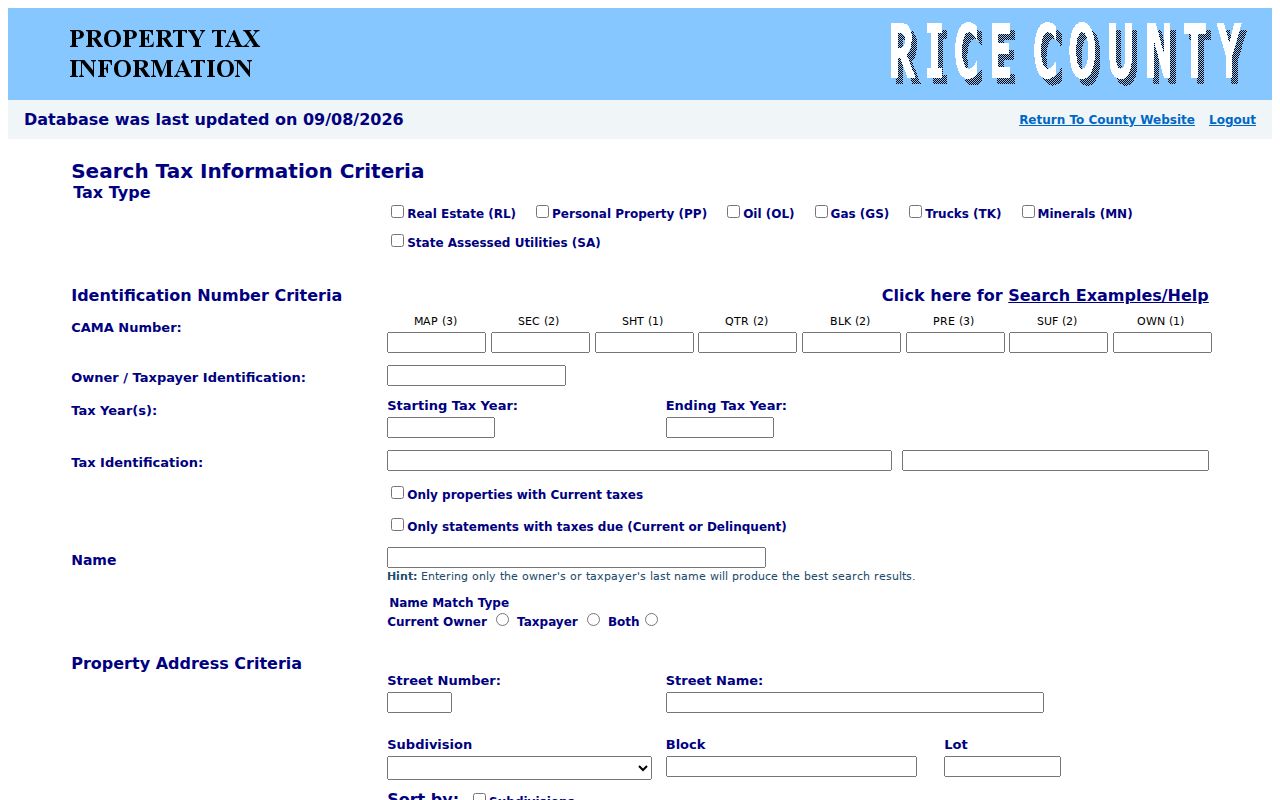
Unusually broad fields and separate tax filters fill the screen.
Look Up a Rice County Tax Bill
Start narrow and widen only if nothing comes back. An exact Quick Ref or parcel number beats a name for precision. Street fields work well when the identifier is unknown.
- Select Real Estate, then search the Treasurer database by address, owner, Quick Ref, Parcel, or the CAMA components.
- Record the tax year and whether the current-tax or taxes-due filter was active.
- Compare the identifier with the Rice County Appraiser valuation record.
- Ask the Rice County Treasurer about an unclear balance, payment, or delinquency status.
- Assessed value
- The class-adjusted value to which the levy is applied.
- Mill levy
- The combined rate of the taxing units; Kansas calculates tax as assessed value times mills divided by 1,000.
- Exemption
- A legally authorized removal or reduction of taxable property; eligibility must be established through the proper form.
- Tax lien
- A claim arising from unpaid tax; confirm its current status with the Treasurer and any recorded instrument with the Register of Deeds.
For phone help, dial the Appraiser at 620-257-3830. Counter visits work as well. The courthouse offices sit at 101 West Commercial in Lyons. Weekday hours are generally 8:00 a.m. to 5:00 p.m. A narrow written request under the Kansas Open Records Act is another route to a record the public screen does not expose, and the office may charge lawful copying, staff, and mailing costs.
Keep Rice County's Eight-Part CAMA Number Intact
The portal splits CAMA into MAP, SEC, SHT, QTR, BLK, PRE, SUF, and OWN. Each displayed width is fixed. The segments run three, two, one, two, two, three, two, and one characters respectively. This segmented key is a Rice County quirk. It is not universal parcel-number grammar. Preserve leading zeroes and punctuation exactly as displayed. If a copied identifier fails, try Quick Ref or Parcel rather than rearranging components.
Note: Save the database date with a Rice County property tax record. Keep the exact identifier too, so a later update can be reconciled.
Agricultural Use Changes the Rice County Value Reading
Kansas agricultural valuation guidance explains that qualifying agricultural land is valued by productivity and use. Agricultural improvements get separate treatment. A farm parcel should not be compared casually with a residence, commercial building, or vacant town lot. Verify class, acreage, and improvement treatment first. Only then judge whether two assessed figures clash. The distinction matters across Rice County's rural sections. The tax search supports section, township, range, lease-name, mineral, oil, and gas criteria alongside ordinary address fields. Those controls help find the right account, though they do not explain the appraisal method.
Current Tax and Taxes Due Are Different Filters
One checkbox limits Rice County results to properties with current taxes. Another limits them to statements with taxes due, current or delinquent. Record which filter produced a result. A blank under one filter proves nothing. A taxes-due status alone does not mean a tax sale is scheduled. Court, notice, and recorded documents supply that context.
Cross-Check the Tax Roll With the Rice Appraiser
The Treasurer's statement answers a billing question. The Appraiser's file supplies the valuation context behind it. The county's Appraiser navigation guide points to Real Estate Parcel Information, then Public Access, where any combination of name, address, Quick Ref ID, or Parcel can be entered. The public entry redirects through Orion's login landing page. It displays a database update of September 8, 2026 at 3:02 a.m. That is six days behind the tax portal. Label which system supplied a figure. The two databases do not move in lockstep. A full parcel card may not surface on the public web view. Fields such as land value, improvement value, sale history, sketch, exemption, and the exact owner-of-record label should not be promised. If the web route stalls, the Appraiser states that Property Record Cards can be requested by telephone at 620-257-3830. It is a documented access channel. The Rice County Orion landing page shows where the public entry lands.
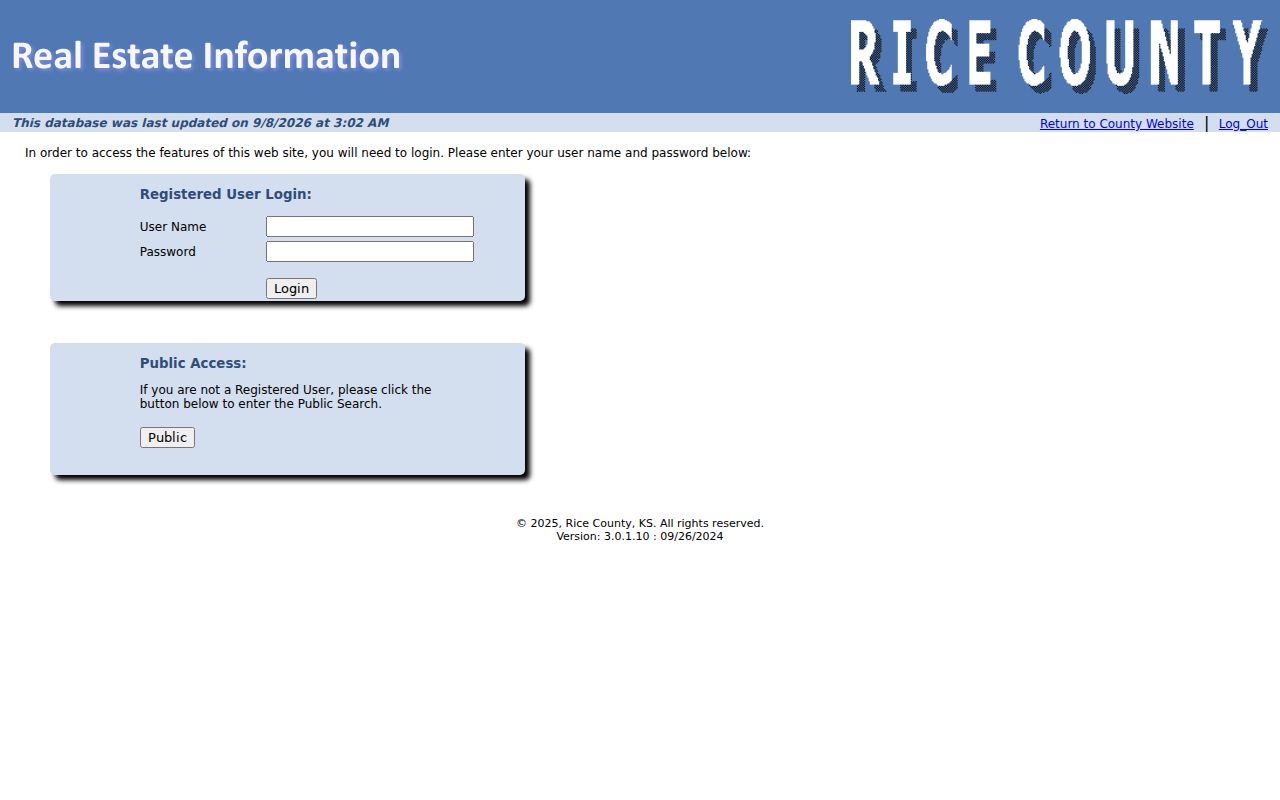
A timestamp covers the whole Rice County database. It cannot confirm that any single transfer, split, correction, or appeal decision has already reached the tax roll.
How Kansas Turns Rice Value Into Tax
Kansas builds a tax bill in three distinct steps. The Rice County Appraiser sets appraised value first. Classification converts that number into assessed value. The mill levy finishes the work, and the Kansas Department of Revenue tax formula guide walks through all three stages. The math is plain. Multiply assessed value by the mill levy and divide by 1,000.
When a bill moves, an input moved first. The trigger may be a new appraisal, a classification or exemption change, a different levy, or several of those at once. Why do bills rise while rates hold steady? The taxable base and the levy are separate inputs, so compare the same tax year, property class, valuation notice, taxing-unit levies, and exemption status before isolating a cause.
Sales inform mass appraisal. Even so, a recorded sale is neither automatically the appraised value nor the assessed value. Rice County's 2024 market study offers countywide market context without quoting a current value for every parcel. The Register of Deeds also restricts the Kansas Real Estate Sales Validation Questionnaire to tax protesters and Kansas Certified General Real Property Appraisers, while ordinary recorded instruments remain open.
When Rice County Property Tax Records Need a Request
A portal screen is only one access channel. For valuation details, contact or visit the Appraiser; for balances and payments, contact or visit the Treasurer; for levy and tax-roll administration, use the County Clerk. These offices are concentrated in the Rice County Courthouse in Lyons, which allows a researcher to reconcile records during one courthouse visit while still asking each custodian only for the record it maintains.
Under K.S.A. 45-215 et seq., ask for an existing, identifiable record and give the parcel key, tax year, record type, and preferred delivery format. An agency need not create a custom compilation and may assess lawful staff, copy, and mailing costs. If a request is denied, the response must identify the legal basis. A focused request for a particular notice, roll entry, or statement is more effective than asking an office to research the entire history of a property.
Note: Confirm current fees, office hours, and appeal dates before relying on an older Rice County publication.
Contest a Rice County Assessment on Time
Rice County's 2026 valuation notices went out March 10. The Appraiser set the informal real-property appeal deadline at April 10, 2026, or 30 days after the notice was mailed. Prepare before that meeting. Check the parcel identity, classification, land and improvement details, and comparable evidence, then use the Kansas property valuation appeal guide for the equalization and payment-under-protest routes.
Appeal window. A notice controls the deadline. For Rice County's 2026 cycle, act by April 10 or within 30 days after mailing rather than waiting for the tax bill.
The county Appraiser page posts appeal applications, exemption and grievance material, an open-records request, and a mailing-address change form. Missed the informal window? Kansas still offers another route. The Kansas payment-under-protest instructions say the form generally goes to the Treasurer by December 20 or with a later payment; qualifying escrow or tax-service payments made before December 20 have until January 31. Confirm the current year's dates instead.